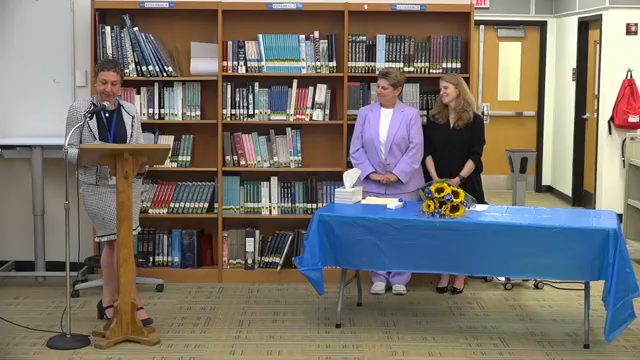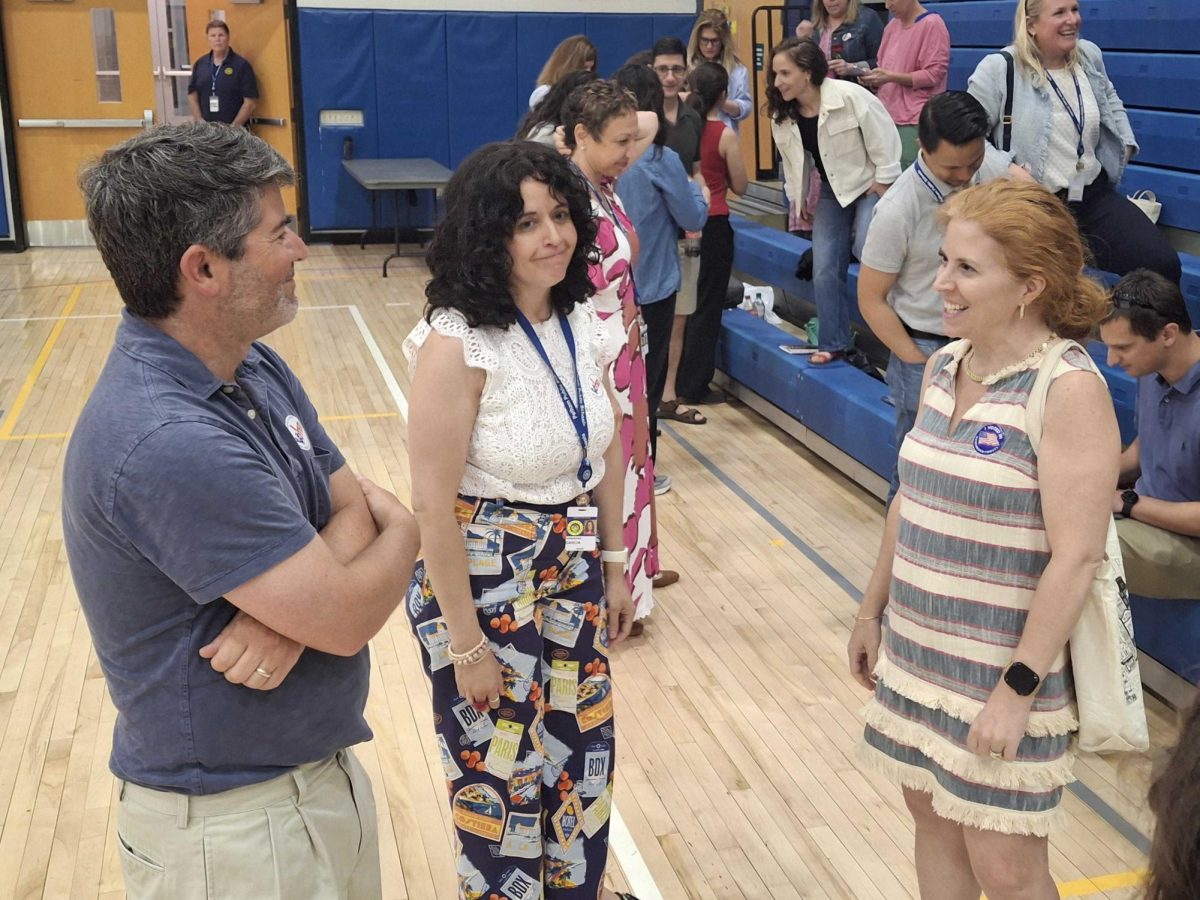


Two incumbents from the Pelham Board of Education and one challenger faced off at a forum on Monday where all three made the case for why they should be elected for the two positions up for grabs on May 19, when town residents will vote on the annual school budget.
Annemarie Garcia and Sid Burke, who were elected to the board in 2023, talked about their experience dealing with challenges facing the school district over the past three years. Lisa Martino Alves, who is principal of Hendrick Hudson High School, talked about her experience as an educator and how that would help her on a board that has no full-time teachers or administrators.
The candidate forum, held on May 11 by the League of Women Voters, featured a variety of questions for the candidates submitted by members of the community. The topics ranged from education-focused issues, including real-world learning and the impact of artificial intelligence on the schools, to student well-being and the quality of the district’s facilities, specifically, the lack of adequate air conditioning during heat waves.
The question that appeared to generate the most interest involved AI, and its impact on education.
Annemarie Garcia said the board has been grappling with this question, and that it’s not clear what the job market is going to look like when today’s fifth graders graduate. “What we can do is take a measured approach where we don’t put our head in the sand, but at the same time, we make sure that we’re paying attention to our students’ academic needs, but also their well being,” she said. “The other piece of it is that at the end of the day, there is nothing that’s going to replace critical thinking, human interaction. AI should be a supportive tool to what goes on in the classroom and not replace teacher supports, teacher guidance, interaction between students… Students need to be critical thinkers in our world, because that’s going to be necessary regardless, no matter where AI takes us.”
Lisa Martino Alves noted that teachers have been challenged for years with the question of whether students’ work is the product of their own authentic thinking, using models that are now outdated. “AI is changing quicker than we can train teachers and we can prepare ourselves and our students, but we have to be very, very proactive here, and that means having a balanced approach in terms of understanding and thinking about guidelines…. and also academic honesty and developing a code of conduct to deal with that. But that’s really only one very small piece, because this is very integrated in our lives as adults….Teachers need to really be trained and thinking about intentional uses, and not uses of screens in their classrooms.”
“AI is a challenge for all of us,” said Sid Burke who works at a major law firm. “It’s a challenge for us in our careers. It’s going to be a challenge for us to for our our children to deal with. We don’t have all the answers. I am responsible for associate training at my law firm. We’re still working through what that looks like and how we’re going to really make it work for for us, for our youngest associates, and how we can build their skills to be able to use AI, because we recognize that it’s going to be an essential skill… I think the district has done a good job of going slow to go fast, so trying to do deep learning on this build their competency internally. The expectation is AI doesn’t have a place in elementary school classrooms, maybe students start getting exposed to it later in middle school. It’s going to have to have some role or some place in high school, because kids can’t leave high school, not knowing anything about how to use it, what the risks are about it, and how to use it well.”
Another question involved what “pet project” or proposal each candidate would bring forward to the board and superintendent. Burke said he wanted to continue his efforts to improve pedestrian safety for students walking from the high school to Glover field. Burke noted the various challenges facing this project, including working with the city of Mount Vernon, which owns the traffic light between the exit from the Hutchinson River Parkway and the entrance to Glover Field. The need to coordinate with several jurisdictions has slowed down the pace of this project. “I think there’s a path there, and I think we can make it happen in the next three years,” Burke said.
Garcia mentioned increased communication between the board and the community. She suggested that it may be more efficient for the board to execute communications for the district, as opposed to the superintendent and administrators whose schedules are already occupied with a variety of other issues. She noted that heightened transparency between the board and community can allow parents and members of the district could more deeply inform the community on decisions made by the board.
Martino Alves praised the high school’s science research program and suggested taking that model to other disciplines. “We have students who are not as engaged in science, but may be amazing and interested and passionate about the arts, about the humanities, about literature, about history, about civics, and we want to provide those opportunities,” she said.
Candidates then delivered closing statements reflecting their overarching goals for policy should they be elected on May 19.
“Every interaction I’ve had with the schools, whether as a trustee or a volunteer, has not just been about my own students and my own children,” she said. “It’s been about all the students in Pelham. It’s about supporting them on whatever their path to excellence may be, and that’s different for everyone. And we’ve really been focused on that, that every child’s path will look different, and it has to be right for them. So I want to continue my work on the board to support them academically and emotionally on whatever their path may be in the future.”
Burke reflected on the last three years he’s served on the board. “When people ask me what it’s like to be on the school board, I usually tell them that it takes a lot of time, but I found it really interesting and rewarding,” he said. “I’ve leaned into my role as a board member to do more than just show up for long meetings, including raising my hand to lead the policy committee for the last two school years which…has addressed 80 policies, which is starting to make a dent into a long backlog of policies in need of review.” He added that he is “ready to continue to make thoughtful contributions to the school board.”
Alves said the Board of Ed’s role is growing in importance. “I’m running for the board because questions once asked and addressed and answered at the state level are no longer going to be answered at the state level,” she said. “They’re going to be local decisions. I want to ensure there’s a perspective of a life-long educator who is 100 percent dedicated to our students…to contribute to that discussion, to add value to the board.“
All three candidates urged residents to vote on Tuesday, May 19, at the middle school gym.