

At least 25 residents attended last week’s Village of Pelham Board of Trustees meeting, with several urging the panel to retract a “blight study” that portrayed a pair of gas stations on Wolfs Lane as unsightly and detrimental to the neighborhood. Residents also asked Mayor Chance Mullen and the board to rescind a “memorandum of understanding” with a local developer whose task was to come up with plans for the gas stations as well as the Pelham Picture House.
The attendees included members of the Staropoli family that owns the Pelham Heights Service Station at 151 Wolfs Lane, as well as residents of Manning Circle, which abuts the properties, and a local lawyer, among others.
Prior to the public comment portion of the February 24 meeting, Mullen expressed contrition for the furor he created two weeks earlier, when the trustees voted in favor of a resolution to designate a preferred developer for the Picture House and adjacent properties, including the gas stations. The contract with the developer, PHP Partners, empowered the village to seize the gas stations by eminent domain, if necessary, as part of a long-range redevelopment project.
Mullen backed away from that resolution on February 18, when he issued a statement saying he was willing to let talks proceed between another developer, JMJ Contracting & Development, and the Picture House. James Smithmeyer of JMJ completed the purchase of the vacant lot beside the Picture House in December and had proposed a development that would only involve the cinema and his property, with no impact on the gas stations.
“There is no condemnation agreement with the developer,” Mullen said at last week’s meeting. “Even if we wanted to use eminent domain against the operating gas stations–and we don’t want to–it simply wouldn’t be feasible. And if there was ever a point where that was the question in front of this board, I haven’t spoken with everybody, but I can’t imagine a single person voting for it. So I’m sorry, I was not able to communicate that better. I wish I could have and I’m sorry for the alarm it caused.”
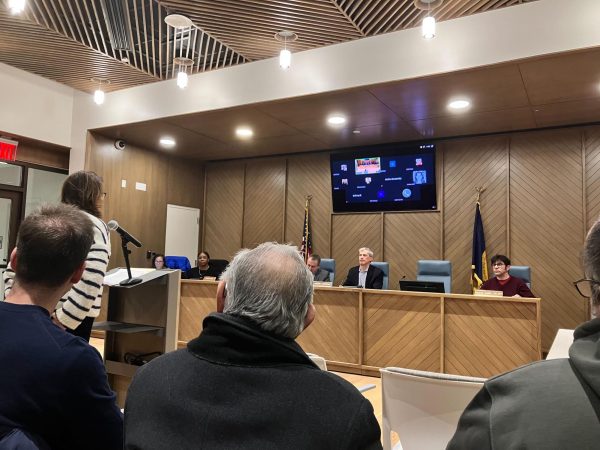
The first speaker, Catherine Staropoli, described her family’s business and its deep roots in the community. “My family has owned the property located on 151 Wolf Lane and the business for almost 60 years,” she said. “This property represents not just a business, it represents a legacy and a part of our community’s history…I also respectfully request, based upon what you just stated, that the resolution from the last meeting be withdrawn as well as the blight report because the blight report is full of inaccuracies, false statements. It says we do not sell gas….You’ve allowed the documentation to be submitted that has incorrect information that’s interfering with our business now because one, we were told that our property was sold months ago and then now we’ve been told that we do not sell gas. Clearly the EPA would stop us with having a canopy and pumps if we weren’t selling gas. So I think that that resolution must be withdrawn as well as the Blight report since it’s inaccurate. I hope the board will consider consider our family’s legacy and the importance, transparency, fairness and accurate information in these decisions.”
Next, Alexis McCarthy, granddaughter and niece of the owners of the station, shared her experience growing up around the business. “It’s been more than a place to get gas or get your car repaired,” McCarthy said. “It’s a place where neighbors see each other, stop to talk, and where generations of families build relationships with us. My brother and I grew up there, many people referring to us as the babies in the playpen, while my family worked long hours.”
Those same neighbors “watched me grow up as I began spending my summers and free time working at the gas station,” she said. “That’s what community looks like.” Towards the end of her statement, McCarthy told the trustees that their action “sends the message that decades of history, relationships, and loyalty no longer matter and that they can simply be replaced. This is not about property, it’s about people. It’s about respect. It’s about whether we value families and small businesses that have invested their lives here. Pelham is special because of its people, because of its families who stay, and because of the small businesses that serve generation after generation.
You’re not just deciding the future of a property, but you’re also deciding the future of what kind of community we choose to be.”
Next up was Rosemary Brooke of Sparks Avenue. “I’ve been a resident of Pelham for 53 years and I’ve seen a lot of changes, but for the life of me I cannot understand, even though you just said you explained this, why you would even consider putting out your RFQ or whatever you call it involving private property and getting back into developing partnerships when there is so much already going on in the village that you are working on… You are working on the storm management, you’re working on the flood mitigation. What would prompt you to want to even think about including two private properties in your decision to go forth and do what you’ve already done?”
Brooke also said she’d heard from neighbors who were upset about the trustees’ decision. “I would ask you to please think of the whole village and try to figure out how not to get everybody so upset,” she said. “And believe me, a lot of people are upset. I’ve read emails where people did not want to support the Picture House anymore because of what went on… So I came here to say say that tonight, please don’t think about taking private property.”
Pelham resident and attorney Michael Bowe then came to the lectern to ask the board about the status of the memorandum of understanding with PHP Partners. Mullen admitted that he didn’t know specifically. Bowe warned that memorandum contained a “provision for condemnation” that could be used to put pressure on the owners of the gas station properties. “The MOU requires the town to negotiate in good faith for a redevelopment agreement, and it requires that that redevelopment agreement have a condemnation agreement in it, which provides that the Town has that authority to exercise in the event that the developer, after good faith and reasonable efforts, cannot secure a sale.”
“What I’ve seen many times,” Bowe continued, “is a town leans on the property owners. So a developer can go to them and say, ‘you should sell to me or you better sell to me, otherwise the town is going to take your property.’ And that is the dynamic that is currently in place. I’m not saying you intended that, but the current dynamic in place with the MOU puts the owners in duress. And so your comments this evening obviously alleviate that somewhat, but they don’t have any legal effect. And so I share the view that the MOU, the resolution, should be withdrawn.”
Rachel Adams of Manning Circle then came to the podium. She recalled the laughter with which the mayor dismissed the question of eminent domain two weeks earlier, but reminded the board that it was a real possibility. “In the blight study, it referred to the New York Municipal Law Code 18-C, which states that the purpose of blight report is to employ the power of eminent domain to advance or expend public funds for these purposes, and to provide a means by which blighted areas may be redeveloped or rehabilitated. That is the code that the blight report stated was applicable in this state. So the blight report should be repealed, it should be rescinded, it should be pulled out, it should be taken out. It should be officially determined to be an inaccurate and an unfair thing to happen.”
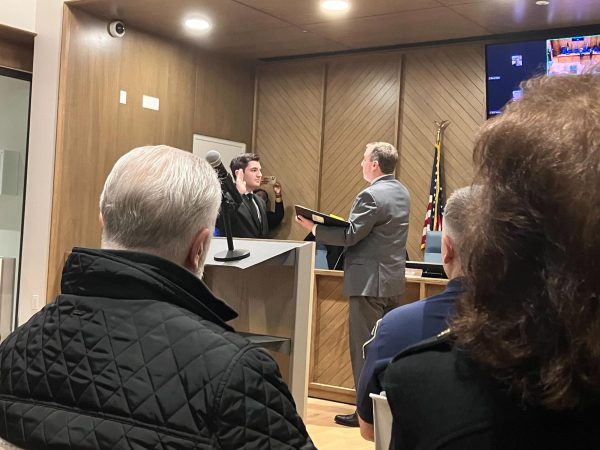
Prior to the discussion about the blight study and eminent domain, Mullen swore in the newest member of the Village of Pelham Fire Department, Anthony Romano.